Guides
Vardzia and Rabati from Tbilisi
Vardzia is a 12th-century cave monastery cut into a cliff above the Mtkvari river in southern Georgia. It is 260 to 270 km from Tbilisi, and the road runs through Borjomi and Akhaltsikhe. Rabati Castle stands in Akhaltsikhe, and Khertvisi fortress is on the way to the caves. By car you can see all of it in one long day, but with a night on the way the trip is more relaxed.
The road from Tbilisi and from Borjomi
Vardzia is 260 to 270 km from Tbilisi. You take the E60 highway to Khashuri, then follow the Mtkvari gorge through Borjomi to Akhaltsikhe. From there the road goes through Aspindza, turns up the Mtkvari at Khertvisi fortress and ends at Vardzia. Without stops it is 4 to 5 hours by car.
Akhaltsikhe is about 205 km from Tbilisi, 3 to 3.5 hours by car. Vardzia is another 60 km or so, 1 to 1.5 hours along the gorge.
From Borjomi, Vardzia is about 110 km, 2 to 2.5 hours by car. From there Vardzia and Rabati fit easily into one day. For Borjomi itself, see our guide to Borjomi and Bakuriani.
Minibus or car with a driver
There is hardly any direct transport to Vardzia, so most people change in Akhaltsikhe. Minibuses to Akhaltsikhe leave Didube bus station every 40 to 60 minutes from 7:00 to 19:00. The fare is 15 GEL and the ride takes 3 to 4 hours. Minibuses also run from Borjomi to Akhaltsikhe, about an hour away.
From Akhaltsikhe, minibuses to Vardzia leave only a few times a day. In summer they go at about 10:30, 12:20, 16:00 and 17:00 or 17:30. The ride is about 1.5 hours and the fare is 7 to 8 GEL. Going back, they leave Vardzia in the morning and at about 15:00, which is the last one. The timetable changes, so check it at the bus station. A direct minibus from Didube to Vardzia leaves around 10:00, but not every day. It takes about 5 hours and costs 22 GEL.
Doing it in one day by minibus hardly ever works. You need the morning minibus from Akhaltsikhe, the 15:00 one back from Vardzia and then one of the last minibuses to Tbilisi. Miss any of them and you spend the night in Akhaltsikhe anyway. Without a car, plan a night in Akhaltsikhe or near Vardzia from the start.
With a driver, Vardzia works as a day trip from Tbilisi, even if it is a long one. You are picked up at your hotel early in the morning, the car waits at Rabati and at Vardzia, and you choose where else to stop. The price is fixed and you pay the driver at the end of the trip. Write to us and we will tell you the price.
A short history
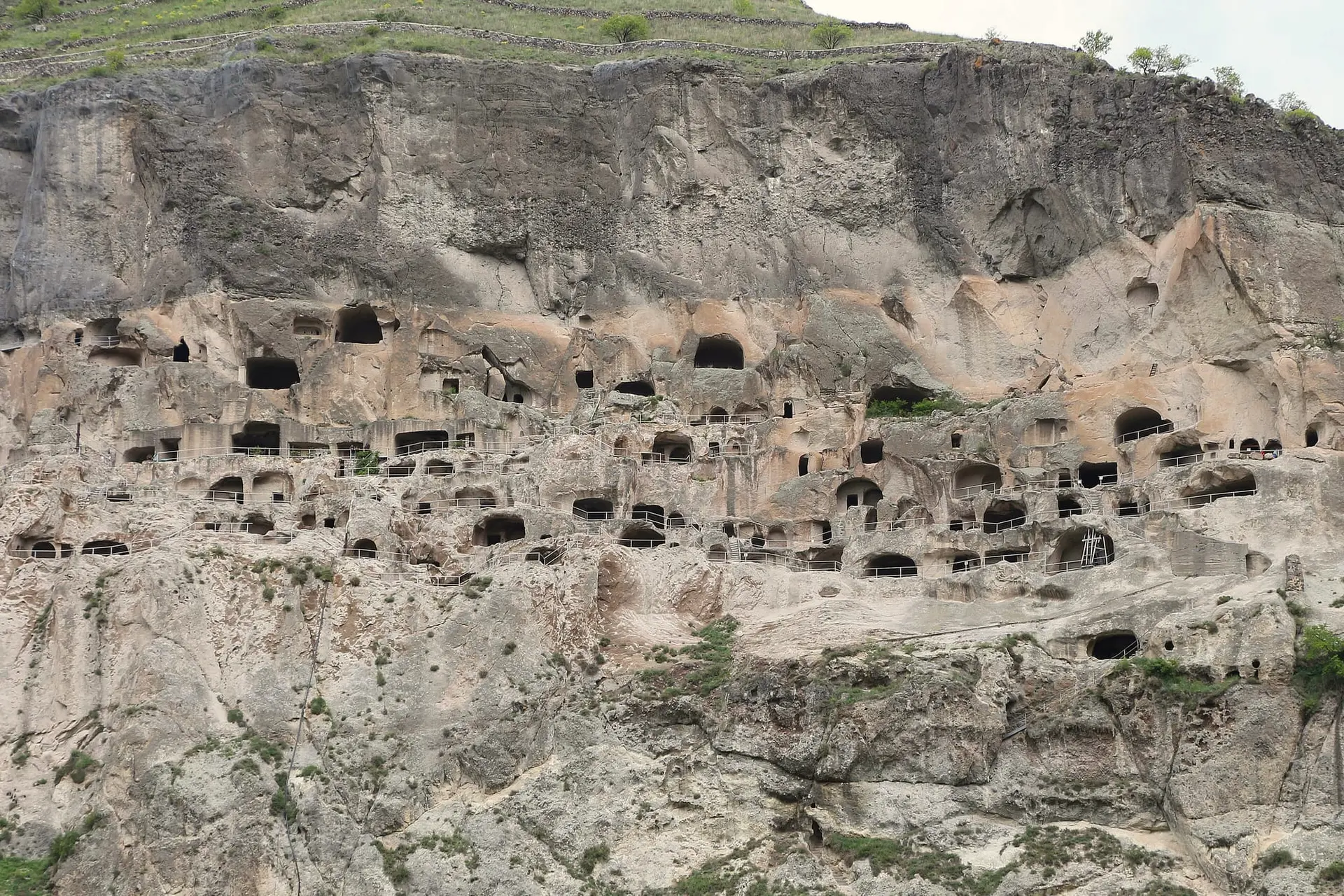
Work on Vardzia began under King Giorgi III in the second half of the 12th century and went on under his daughter, Queen Tamar. The caves were cut into the side of Erusheti mountain on the left bank of the Mtkvari. It was a monastery and also a refuge on the southern border of the kingdom. The caves run along about 500 m of cliff, in 13 levels today. Legend says the young Tamar got lost in the caves and called out “Ak var, dzia”, meaning “I am here, uncle”, and that is where the name comes from.
In 1283 an earthquake brought down the outer slope of the mountain. Many rooms collapsed, and the rest were left open to the valley, which is how you see them today. In 1551 the army of the Persian Shah Tahmasp sacked the monastery, and after the Ottomans arrived in 1578 the monks left. Monks live at Vardzia again today, and their part of the complex is closed to visitors.
What you see inside
The main sight, the Church of the Dormition, is also cut into the rock. Its frescoes were painted in 1184-1186 and include portraits of Giorgi III and Tamar holding a model of the church. It is one of the few portraits of the queen made in her lifetime. Cover your shoulders and knees for the church, and women may want a headscarf.
Around the church are living cells, a refectory, bakeries and wine cellars with qvevri, the clay wine jars, set into the floor. Water reached the caves through a 3.5 km channel from the village of Zeda Vardzia. There is also a small spring known as Tamar's Tears.
In the early hours of 27 May 2026 a rockfall near the so-called Secret Tunnel damaged the footpath and its railing, and that section was closed. In September the National Agency for Cultural Heritage Preservation said it was starting work to clear the debris, put up safety nets and repair the handrails. While the work goes on, the route ends after the Church of the Dormition and you walk back the same way. No date for a full reopening has been given, so check what is open before you go.
The climb, the tunnels and tickets
The route follows stone and wooden stairs and open terraces along the cliff. The steps are old and uneven, with sand on them in places. Wear closed shoes with a good grip, and in summer bring water and a hat.
The levels are linked by tunnels. Some are low and narrow, so you walk bent over, and the longest run for more than 150 m. Normally the route ends with a long, narrow tunnel down steep steps. If tight spaces bother you, it helps to know this in advance, and a phone torch is useful. While the closed section is being repaired, nobody goes through that tunnel. The route is no place for a pushchair, and small children need a hand on the stairs.
- Entry is 15 GEL, free for children under 6. An audio guide costs another 15 GEL.
- Vardzia is open every day from 10:00. It closes at 19:00 from 1 May to 30 September, at 18:00 in March, April and from 1 October to 14 November, and at 17:00 from 15 November to the end of February.
- A shuttle runs from the ticket office to the start of the route for 2 GEL. On foot it is about 1 km uphill.
- Allow 2 to 3 hours, closer to 3 with the audio guide.
Rabati Castle in Akhaltsikhe
Rabati stands on a hill in the middle of Akhaltsikhe. From the 13th to the 16th century it was the seat of the Jaqeli princes who ruled Samtskhe. The Ottomans took it at the end of the 16th century and held it until 1828. From their time there is an 18th-century mosque with a golden dome and a madrasa. The fortress was rebuilt in 2011-2012 and now looks almost new, which is why the restoration has had a lot of criticism.
The lower courtyard with cafés, souvenir shops and a hotel is free. You need a ticket for the upper part with the mosque, the Jaqeli palace and the towers. It costs 20 GEL for foreigners and 10 GEL for Georgian citizens and residents, and children under 6 go free. An audio guide is 15 GEL. The castle is open every day from 9:00 to 18:00, later in summer. The history museum in the old Jaqeli palace is closed on Mondays.
An hour to an hour and a half is enough for Rabati. From the flag tower you see the whole town.
Khertvisi, Sapara and Tmogvi
Khertvisi fortress stands on a rock where the Paravani river meets the Mtkvari, right by the road and about 16 km before Vardzia. The walls you see were probably built in the 10th to 11th centuries, but people lived here long before that. In 1771 King Erekle II briefly took it back from the Ottomans. A stop here takes 20 to 40 minutes.
Sapara Monastery sits in a wooded gorge 12 km from Akhaltsikhe. It has existed since at least the 9th century. In the late 13th century it passed to the Jaqeli family, and Beka Jaqeli built the church of St Saba, painted in the 14th century. It is a working monastery, so shoulders and knees must be covered. With the drive there and back, Sapara takes 1 to 1.5 hours.
The ruins of Tmogvi fortress stand on a cliff above the Mtkvari a few kilometres downstream from Vardzia. Earthquakes damaged it several times, including in 1283. There is no ticket, but the path is steep and easy to lose in places, and the climb takes about an hour. It suits a two-day trip better than a single day.
A one-day plan
The day takes 13 to 14 hours, about 9 of them in the car. See Rabati on the way out, because by the time you come back in the evening it may be closed.
- Leave Tbilisi at 7:00 and reach Akhaltsikhe around 10:30.
- Rabati, 1 to 1.5 hours.
- Around 12:30, a short stop at Khertvisi fortress.
- Around 13:00, Vardzia. The shuttle to the start of the route and 2 hours in the caves.
- Around 15:00, a late lunch at one of the cafés near Vardzia.
- Head back at 16:00 and you are in Tbilisi around 20:30 or 21:00.
Two days with a night on the way
With a night on the way nothing is rushed, and you can be at Vardzia when it opens, before the tour groups from Tbilisi arrive.
On the first day you leave Tbilisi at 9:00, walk in the park in Borjomi and have lunch there. Then you see Rabati and, if there is time, Sapara Monastery. You sleep in Akhaltsikhe or at a guesthouse near Vardzia.
On the second day you are at Vardzia by 10:00, then stop at Khertvisi and, if you have the legs for it, climb to Tmogvi. After lunch you drive back and reach Tbilisi in the evening.
Akhaltsikhe has plenty of hotels, one of them right in the lower courtyard of Rabati. Next to Vardzia and in nearby villages such as Tmogvi there are guesthouses, a few minutes' drive from the caves in the morning.
Our Borjomi and Bakuriani tour can be extended on request. Rabati adds about two hours and makes it a long day. With Vardzia it becomes a two-day trip with a night in Akhaltsikhe or near Vardzia, priced on request. Child seats are free. If you are simply staying in Borjomi for a few days, book the Tbilisi to Borjomi transfer.
Questions and answers
How far is Vardzia from Tbilisi?
260 to 270 km via Borjomi and Akhaltsikhe. By car it takes 4 to 5 hours without stops. By minibus it is 3 to 4 hours to Akhaltsikhe and about 1.5 hours more to Vardzia.
Can I do Vardzia as a day trip from Tbilisi?
By car, yes, but the day lasts 13 to 14 hours. By minibus it does not really work, so plan a night in Akhaltsikhe or near Vardzia.
How do I get to Vardzia by public transport?
Take a minibus from Didube bus station to Akhaltsikhe. They leave every 40 to 60 minutes and cost 15 GEL. From Akhaltsikhe a few minibuses a day go to Vardzia for 7 to 8 GEL, and the last one back leaves around 15:00.
How much is the Vardzia ticket and is everything open?
The ticket is 15 GEL and the shuttle to the start of the route is 2 GEL. Vardzia opens at 10:00 and closes at 17:00, 18:00 or 19:00 depending on the season. After a rockfall in May 2026, part of the route beyond the Church of the Dormition is closed for repairs, and no reopening date has been given.
How much is the ticket to Rabati Castle?
20 GEL for foreigners and 10 GEL for Georgian citizens and residents, free for children under 6. The lower courtyard is free to enter. The castle is open every day from 9:00 to 18:00.
Plan the trip
The transfer and the tour from this article, at a fixed price per car. Questions go to WhatsApp or Telegram.
More guides
 Resorts
Borjomi and Bakuriani from Tbilisi
How to get from Tbilisi to Borjomi and Bakuriani by minibus, train or car with a driver. The mineral water park, the Green Monastery and ski pass prices.4 min read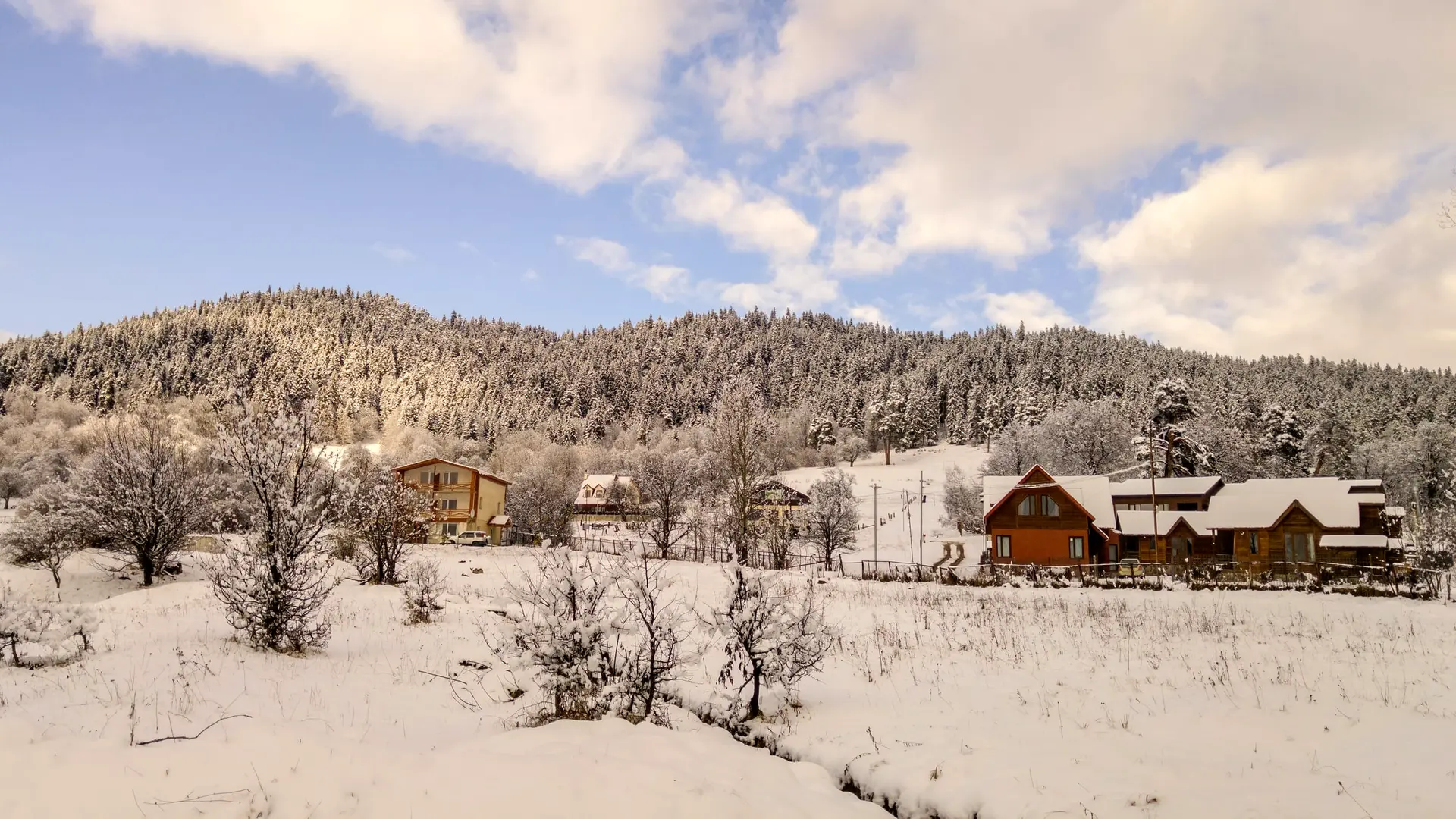 Winter
Getting to Bakuriani in winter
Bakuriani is 190 km from Tbilisi, about 3 hours by car. How to get there by transfer, minibus or train, from Kutaisi too, with ski pass prices and season dates.11 min read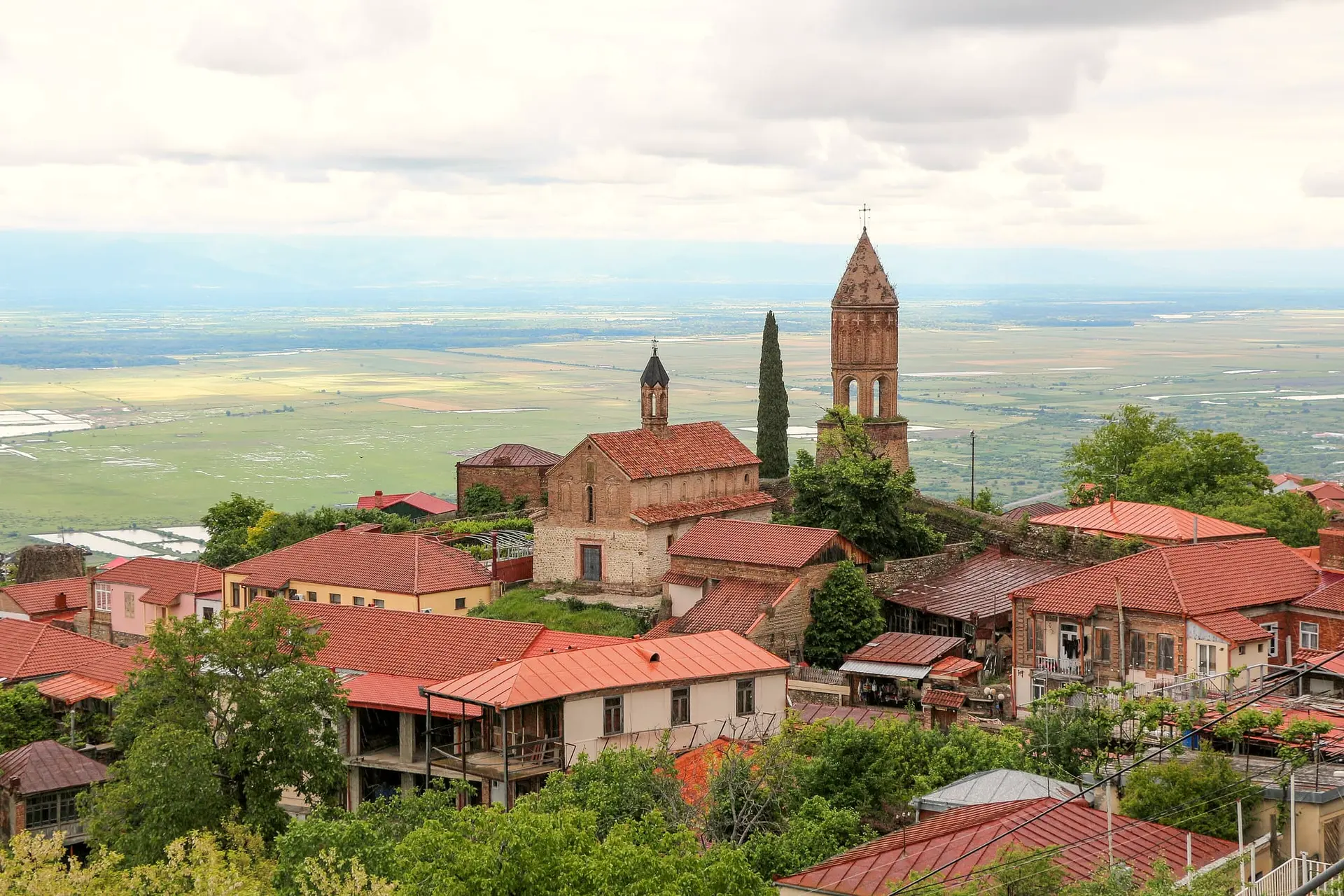 History
Sighnaghi and Bodbe from Tbilisi
How far Sighnaghi is from Tbilisi, where the minibus leaves and when a car with a driver makes sense. The town walls, Bodbe Monastery, wine and a one-day plan.6 min read
Photos: Bernard Gagnon (CC BY 4.0).