Guides
Things to do in Kazbegi and how many days you need
Kazbegi, officially Stepantsminda (1,740 m), is about 155 km and 3 hours north of Tbilisi, and its main sights, Gergeti Trinity Church, Gveleti waterfall, Dariali monastery and the Sno stone heads, are on paved roads, open all year and fit a 10 to 12-hour day trip. The Juta and Truso valleys are open roughly from June to October and need a night in town. In autumn 2026 a local 4x4 cost 50 to 100 GEL per car to Gergeti and back and 100 to 150 GEL to Juta and back, and the best time to come is June to early October, because in winter snow closes both valleys.
What is there to do in Kazbegi?
The main things to do in Kazbegi are Gergeti Trinity Church above the town, Gveleti waterfall and Dariali monastery on the road to the border, the giant stone heads at Sno, Sioni church by the highway, and the walks in the Juta and Truso valleys. Stepantsminda, which nearly everyone still calls Kazbegi, is a small town at about 1,740 m right under Mount Kazbek, and almost everything worth seeing lies within 20 km of it.
- Gergeti Trinity Church, 14th century, 2,170 m. 6 km by paved road or 3 to 3.5 km on foot from the centre. About 1.5 hours by car, 3 to 4 hours on foot. Open all year, 9:00 to 17:00.
- Gveleti waterfall. 7 km north, then 15 to 20 minutes on a path. About an hour. All year, icy in winter.
- Dariali monastery. 10 to 11 km north, next to the border. 30 to 40 minutes. All year.
- Sno stone heads and fortress. About 8 km, on the way to Juta. 40 to 60 minutes. All year.
- Sioni church. 9 km towards Tbilisi, right by the highway. 20 to 30 minutes. All year.
- Juta and the Chaukhi lake. About 20 km. 6 to 7 hours with the drive. June to October.
- Truso valley. About 18 km to the trailhead at Kvemo Okrokana. 6 to 8 hours with the drive. June to October.
Is one day enough for Kazbegi, or should you stay overnight?
One day from Tbilisi is enough for Gergeti and one or two places near the main road, but it makes a 10 to 12-hour day with about 6 hours in the car. Stay one night if you want Kazbek in the morning, when it is most often clear, and two if you also want Juta or Truso. Those valleys do not fit into a day trip from Tbilisi.
In winter a night in town is also insurance. If the Jvari Pass closes, you wait in a warm guesthouse rather than in a car. In December the sun sets around 17:30, so leave Stepantsminda by mid-afternoon to cross the pass in daylight, and keep to one place after Gergeti.
With a driver you choose the stops and the car waits at each one. Our Georgian Military Road tour covers this day in about 11 hours from your hotel in Tbilisi and back. A typical day runs like this.
- 8:00, leave Tbilisi. With two or three short stops you reach Stepantsminda around 12:00.
- 12:00, Gergeti. About 1.5 hours by car or 4x4. On foot it takes 3 to 4 hours, and then you skip the waterfall and the monastery.
- 13:30, lunch in town.
- 14:30, Gveleti waterfall, then Dariali monastery, 1.5 to 2 hours for both.
- 16:30, the stone heads at Sno on the way back, half an hour.
- 17:30, head back and reach Tbilisi around 20:30.
How do you get from Tbilisi to Kazbegi?
Kazbegi is about 155 km north of Tbilisi on the Georgian Military Road, about 3 hours by car without stops and 3.5 to 4 hours in winter. The road is paved all the way and crosses the Jvari Pass at 2,379 m.
Marshrutka minibuses leave Didube bus station about 11 times a day between 8:00 and 19:00, fewer out of season. The fare is 20 GEL in cash, the ride takes 3 to 3.5 hours and it does not stop at the sights (checked in October 2026). By car you can stop at Zhinvali, Ananuri, Gudauri and the Friendship Monument, all described in our guide Tbilisi to Kazbegi.
Our Tbilisi to Kazbegi transfer has a fixed price per car, you pay the driver after the trip and child seats are free. You can book it on the site or in our Telegram bot. Of our cars, only the Toyota Land Cruiser Prado is built for rough roads. Depending on the weather, the climb to Gergeti and the dirt roads to Juta and Truso may need a local 4x4, and the driver will tell you on the spot.
Can you walk up to Gergeti Trinity Church, and how long does it take?
Yes, the footpath from the centre of Stepantsminda to Gergeti Trinity Church is 3 to 3.5 km each way with 400 to 450 m of climb, and takes 1 to 2 hours up and 1 to 1.5 hours down. With time at the top, allow 3 to 4 hours. The path crosses the river and climbs through Gergeti village, and the last part is steep, so wear shoes with good grip.
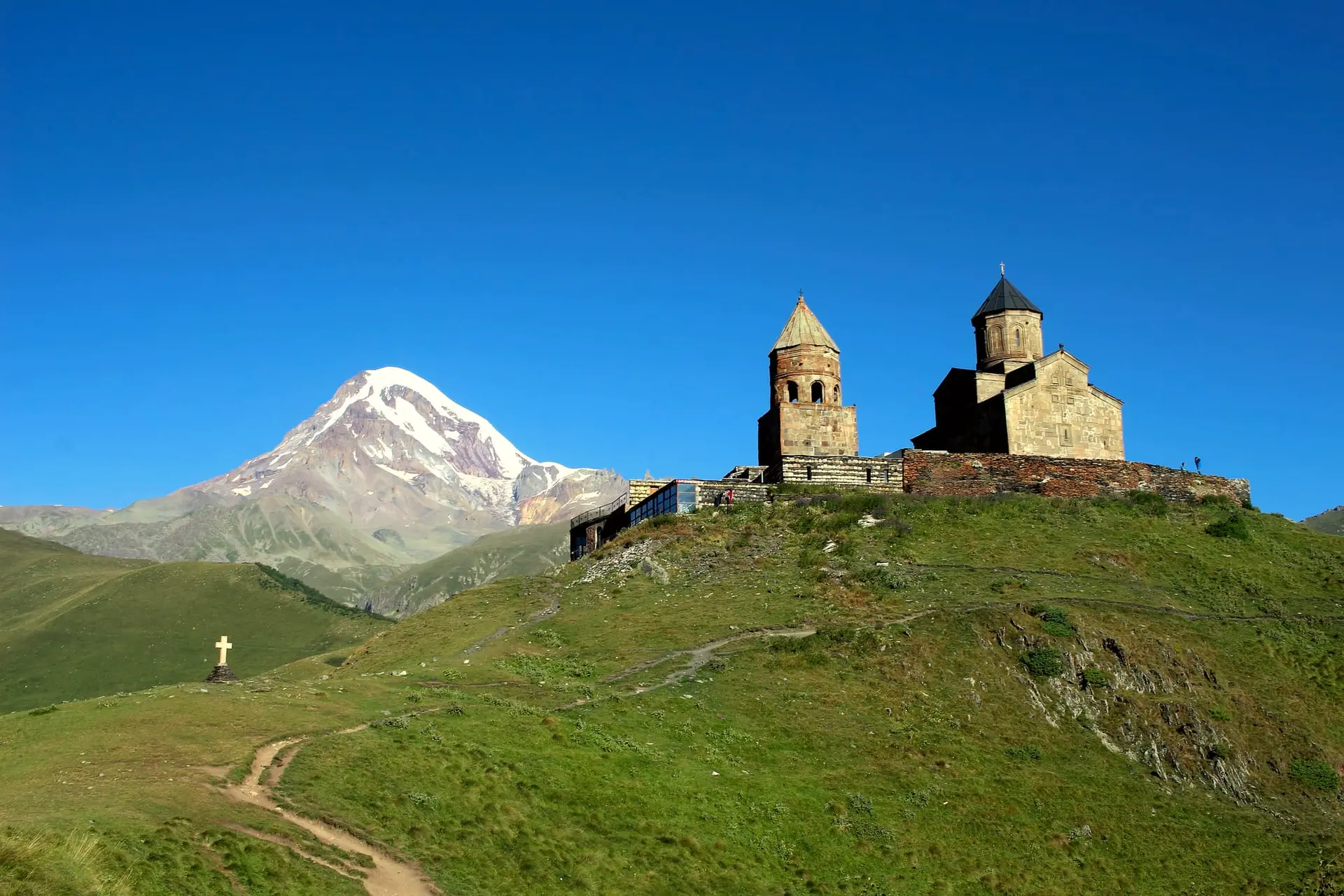
The 14th-century Holy Trinity church stands at 2,170 m. Entry is free and the gates are open from 9:00 to 17:00. Kazbek is clearest in the morning, and by midday the summit is often in cloud.
A paved road of about 6 km goes up too, and in dry weather an ordinary car reaches the car park. Landslides damage it from time to time, and in snow or ice people go up only by 4x4 or on foot. Local 4x4s wait on the main square and take about 20 minutes to the top. In autumn 2026 a seat cost 15 to 25 GEL and a whole car up and back 50 to 100 GEL, with 30 to 45 minutes of waiting at the top.
Shoulders must be covered and men in shorts are not let in. Women wear a skirt and cover their hair. Wraps are handed out at the entrance, but on summer afternoons they can run out. Photos are not allowed inside.
Experienced hikers carry on from the church to the Gergeti glacier and the old meteo station at 3,653 m, now a climbers' hut. To the glacier and back is about 20 km and 8 to 12 hours, and the season is June to mid-October. Reaching the hut means crossing a glacier with crevasses, so go only with experience or a guide.
Does Bolt work in Kazbegi, and what do taxis and 4x4s cost?
Bolt works in Stepantsminda, but it has only a handful of drivers, so do not count on it. In practice people take the local taxis and 4x4s that wait on the main square and by the bus stop, or ask their guesthouse to call one. There are no meters, so agree the price, the waiting time and whether it is per car or per person before you set off.
These are prices per car reported in September and October 2026.
- Gergeti, up and back with waiting. 50 to 100 GEL, or 15 to 25 GEL a seat in a shared 4x4.
- Gveleti waterfall. 50 to 60 GEL plus waiting.
- Sioni. 35 to 40 GEL one way.
- Juta. From 60 GEL one way, 100 to 150 GEL there and back with 3 to 4 hours of waiting. Beyond the closed stretch a local driver charges 40 GEL.
- Truso, to the trailhead at Kvemo Okrokana. 60 to 70 GEL one way, 80 to 140 GEL there and back.
- Shared minibus. From June 2026 Mountain Travel Agency ran a minibus to Juta and to Truso for 45 GEL return, leaving at 9:30 and coming back at 17:00 when at least five people signed up, plus a midday run to Dariali and Gveleti. The Mountain Freaks shuttles stopped in 2026. Late in the season, ask in town whether the minibus still runs.
- Cash. Taxis, 4x4s and the minibus take cash only, and the town's couple of ATMs can run dry on summer weekends, so bring lari from Tbilisi.
- Rental cars. In 2026 most rental firms banned the Juta and Truso roads, and driving there voids the insurance. More in our guide to renting a car or hiring a driver.
Juta or Truso, which valley should you choose?
Choose Juta for the jagged Chaukhi peaks and a shorter walk with a café on the way, and Truso for a long, almost flat walk past ruined villages, mineral springs and a fortress. Both valleys are open roughly from June to October, each needs a free day from Stepantsminda, and in autumn both have better colours than the town itself.
- Juta. A village at about 2,200 m, 20 km from town. The walk to the Chaukhi lake is about 8 km and 3 to 4 hours there and back from the village, or about 13 km with the closed road. The Fifth Season hut, with a café, is half an hour from the village. The best pick for big mountains with little effort.
- Truso. The valley floor runs from 2,030 m to about 2,240 m at Zakagori, 18 km from town to the trailhead. The walk to Zakagori fortress is about 22 km and 5 to 7 hours there and back with about 340 m of climb, less if a 4x4 takes you part of the way. Abandoned Ossetian villages, travertines and a bubbling mineral lake. It is a border zone, so you need your passport.
- Both. With two nights in Stepantsminda you have time for Juta and Truso.
How do you get to Juta and the Chaukhi lake in 2026?
From Stepantsminda you drive about 20 km through Sno to a barrier below Juta, then walk the last 2.6 km, about 40 minutes, or ride with a local driver for 40 GEL. The road below the village collapsed on 17 June 2025, in October 2026 that stretch was still closed to cars, and repairs were planned to run through 2026. Check before you go whether it has reopened.
The asphalt ends soon after Sno and gravel takes over. Local drivers with 4x4s go up from town, and parking at the barrier cost 10 GEL a day in 2026. Juta itself lies at about 2,200 m under the jagged Chaukhi massif and is the highest inhabited village in the Kazbegi municipality.
From the village the trail follows the valley. After 1.1 km, about half an hour, you reach the Fifth Season hut, which has a café. Another 2.6 km brings you to a waterfall and a small lake under the Chaukhi wall. Out and back from the village is about 8 km and 3 to 4 hours, or about 13 km counting the closed road. The walking is easy, but you are above 2,000 m and the weather turns fast, so take a warm jacket even in summer. Experienced hikers cross the Chaukhi pass (3,338 m) to the Abudelauri lakes in Khevsureti, a two-day trek.
Juta's season runs roughly from June to October. In 2026 late snow held it back until June, and the Chaukhi pass can hold snow from early October.
How do you visit the Truso valley, and do you need a passport?
Take a taxi or 4x4 about 18 km from Stepantsminda to the village of Kvemo Okrokana, turning off the highway at Kobi, then walk along the Terek to Zakagori fortress, about 11 km each way and 5 to 7 hours there and back. You do need your passport, because a border police post stands at Zakagori and you cannot go further without a permit.
The road into the valley is dirt, rough in places and muddy after rain. An ordinary car gets as far as Okrokana at best, while a 4x4 can drive on to the first travertines, which cuts the walk to 3 to 4 hours.
On the way are abandoned Ossetian villages. The best known is Ketrisi, mostly in ruins. Near it are white and orange travertine terraces left by mineral springs. By the village of Abano a small mineral lake bubbles with carbon dioxide. Zakagori fortress, at about 2,240 m, is a ruin you can climb up to. There is little shade on the way, so carry water and food.
People visit the Truso valley roughly from June to October. From November to May snow closes the road.
How do you see Gveleti waterfall and Dariali monastery?
Both lie 7 to 11 km north of Stepantsminda on the paved road to the Russian border, are open all year and together take 1.5 to 2 hours. Gveleti waterfall is about 7 km from town. A dirt track of 700 to 800 m leaves the highway, then a rocky path takes 15 to 20 minutes to the big waterfall. There and back is about an hour. The rocks are slippery after rain and the path ices over in winter.
Dariali monastery stands at the narrowest point of the gorge, 10 to 11 km from town, next to the border checkpoint. It is a new monastery of the Holy Archangels, begun in 2005 and consecrated in 2011. Entry is free, 30 to 40 minutes is enough, and the dress code is the same as at Gergeti. Beyond it lies the Russian border, covered in our guide to Upper Lars.
What are the giant stone heads at Sno?
They are huge granite heads of Georgian writers and saints on a hill at the entrance to Sno, about 10 minutes from Stepantsminda, carved by Merab Piranishvili, a sculptor born in the village. Turn off the highway at Achkhoti towards Tbilisi, and the road is paved as far as Sno.
The first and largest, St George on horseback, was finished in 1984. Rustaveli, Ilia Chavchavadze, Akaki Tsereteli, Vazha-Pshavela, Alexander Kazbegi and Jesus Christ followed. There is no ticket, and people usually leave about 5 GEL in the donation box.
Across a small river, the 16th-century Sno fortress stands on a rock in the village. It was the valley's main stronghold against raids. The father of Patriarch Ilia II came from Sno. All of it takes 40 to 60 minutes and fits best on the way to Juta or on the drive back to Tbilisi.
Is Sioni worth a stop, and is the Kazbegi museum open?
Sioni is worth 20 to 30 minutes. Its 9th to 10th-century basilica, known as the Sioni of Khevi, stands right on the main road about 9 km from town towards Tbilisi. A four-storey watchtower rises on the cliff beside it, and a stone wall runs around the church. In the early Middle Ages this fortress guarded the road to Dariali. The stop is easy to make on the way in or out.
In town is the house of the writer Alexander Kazbegi, who was born here. The town itself was officially named Kazbegi from 1925 to 2006. The house holds the local history museum, but in recent years it has been closed for restoration for long periods, and we found no news of it reopening in 2026, so ask in town whether it is open.
What does a two-day trip to Kazbegi look like?
Spend the first afternoon on the sights near the main road, then start the second day early at Gergeti and give the rest of it to Juta or Truso. In summer, book a room ahead.
- Day 1. The drive up with the stops from our guide Tbilisi to Kazbegi, Sioni on the way in, then Gveleti and Dariali in the afternoon.
- Day 2, early morning. Gergeti at 7:00 or 8:00, before the clouds and the crowds. The church itself opens at 9:00, but the view of Kazbek is the reason to come early.
- Day 2, from late morning. From June to October, Juta and the walk to the Chaukhi lake with Sno on the way, or the Truso valley. Each takes 6 to 8 hours with the drive.
- Day 2, evening. Leave around 17:00 and reach Tbilisi around 20:00, or stay a third night and see both valleys.
What is open in Kazbegi in winter, and what in summer?
From June to early October everything is open, including Juta, Truso and the Gergeti glacier trail. From about November to May snow closes the dirt roads to Juta and Truso, while Gergeti, Gveleti, Dariali, Sno and Sioni stay within reach on paved roads.
- June to September. Everything is open and the shared minibuses to the valleys run from June. July and August are the busiest months, so book rooms ahead.
- October and November. Gergeti and Truso are usually fine through October, but snow can fall any week, nights freeze and the Chaukhi pass can hold snow from early October. After mid-October, ask in Stepantsminda before heading to Juta or Truso. By November the valleys are usually closed.
- December to March. The town is under snow, the road to Gergeti ices over and only 4x4s or walkers go up, and the path to Gveleti freezes. Juta and Truso are closed. Instead of hikes there is snowshoeing with a local guide and a ski day in Gudauri. More in our guide to Kazbegi in winter.
- April and May. Snow lingers into April and sometimes May, and the valleys usually open in late May or June. In 2026 late snow held the Juta season back until June.
- Jvari Pass. From about late November to April the road between Gudauri and Kobi closes when the avalanche risk is high, sometimes for several days. Check the Roads Department notices before you set out.
What is the weather like in Kazbegi, and is the altitude a problem?
Stepantsminda, at 1,740 m, is cool all year. Average highs are about 20 °C in July and August, 11 °C in October and -2 °C in January, and nights drop to about 8 °C in summer, 0 °C in October and -11 °C in January. May to August are the wettest months, mornings are usually clearer than afternoons, and summer afternoons can bring hail, so plan Gergeti and the view of Kazbek for the morning.
For most people the altitude is not a problem. Altitude sickness becomes a risk above about 2,400 m, and the town, Gergeti (2,170 m), Juta (about 2,200 m) and the Truso valley (up to 2,240 m) are all below that. The climb to Gergeti can still leave you short of breath. Only the Gergeti glacier, the meteo station (3,653 m) and the Chaukhi pass (3,338 m) go higher, and those are routes for experienced hikers.
Take a warm jacket even in July, as the weather above 2,000 m turns fast.
Kazbegi, Borjomi or Svaneti, which suits a short trip?
With one or two days, choose Kazbegi for high mountains or Borjomi for a quiet spa town with forest walks. Svaneti is about 450 km and 7 to 8 hours away, so it needs at least three days.
- Kazbegi. About 155 km and 3 hours from Tbilisi. Glaciers, Gergeti and hikes from 1,740 m up. It works as a day trip but is better with a night. In winter the Jvari Pass sometimes closes.
- Borjomi. About 160 km and 2.5 hours. The mineral water park and springs and the forests of Borjomi-Kharagauli National Park, with the ski slopes of Bakuriani 30 km higher. The road crosses no high pass, so it works all year. More in our guide to Borjomi and Bakuriani.
- Svaneti. About 450 km and 7 to 8 hours by road to Mestia, or a small plane from Natakhtari. Medieval Svan towers and Ushguli under Shkhara. At least three days. More in our guide to Mestia and Ushguli.
- For more ideas, see our day trips from Tbilisi.
Questions and answers
What are the best things to do in Kazbegi?
Gergeti Trinity Church above Stepantsminda, Gveleti waterfall, Dariali monastery, the stone heads at Sno and Sioni church. All are on paved roads and open all year. From June to October, add the walk to the Chaukhi lake at Juta or the Truso valley.
Is one day enough for Kazbegi?
For Gergeti and one or two sights near the main road, yes, and the day trip from Tbilisi takes 10 to 12 hours. For Juta or Truso and the clear morning view of Kazbek, stay at least one night in Stepantsminda.
Can you walk up to Gergeti Trinity Church?
Yes. The path from the centre of Stepantsminda is 3 to 3.5 km each way with 400 to 450 m of climb. Allow 1 to 2 hours up and 1 to 1.5 hours down, and wear shoes with good grip.
How much is a 4x4 to Gergeti Trinity Church?
In autumn 2026 local 4x4s on the main square charged 15 to 25 GEL a seat or 50 to 100 GEL for the whole car up and back, with 30 to 45 minutes of waiting. In dry weather an ordinary car can drive the paved road too.
Is Bolt available in Kazbegi?
Bolt works, but it has only a handful of drivers, so do not count on it. Local taxis wait on the main square and by the bus stop, have no meters and take cash, so agree the price before you get in.
Juta or Truso, which is better?
Juta for the jagged Chaukhi peaks and a walk to the lake of about 8 km there and back from the village. Truso for an almost flat walk to Zakagori fortress past ruined villages and travertines, about 22 km there and back. Both valleys are open roughly from June to October.
Can you visit Juta and Truso in winter?
No. Snow closes the dirt roads from about November to May, and in late October the first heavy snow can already close them. In winter Gergeti, Gveleti, Dariali, Sno and Sioni stay open.
Is there an entry fee in Kazbegi?
Kazbegi National Park, Gergeti Trinity Church and Dariali monastery are free. At the Sno stone heads people usually leave about 5 GEL in the donation box.
Plan the trip
The transfer and the tour from this article, at a fixed price per car. Questions go to WhatsApp or Telegram.
More guides
 Mountains
Tbilisi to Kazbegi on the Georgian Military Road
Kazbegi (Stepantsminda) is 150 km from Tbilisi on the Georgian Military Road: the stops on the way, marshrutka or a private car.5 min read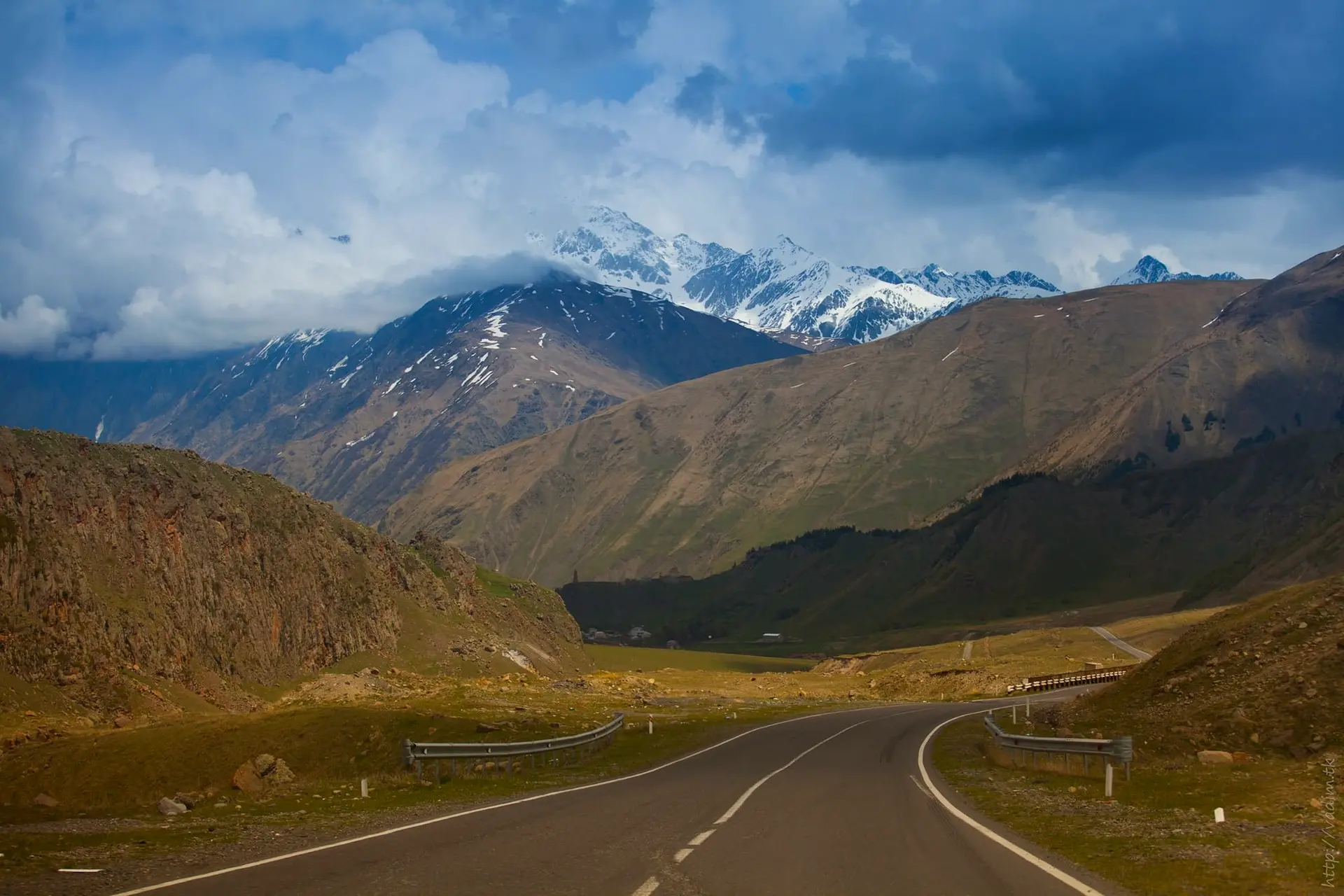 Border
Vladikavkaz to Tbilisi over the Upper Lars border
Vladikavkaz to Tbilisi is about 200 km via Upper Lars. Minibuses, buses, driving, taxis, flights and a private car from the border, checked for 2026.12 min read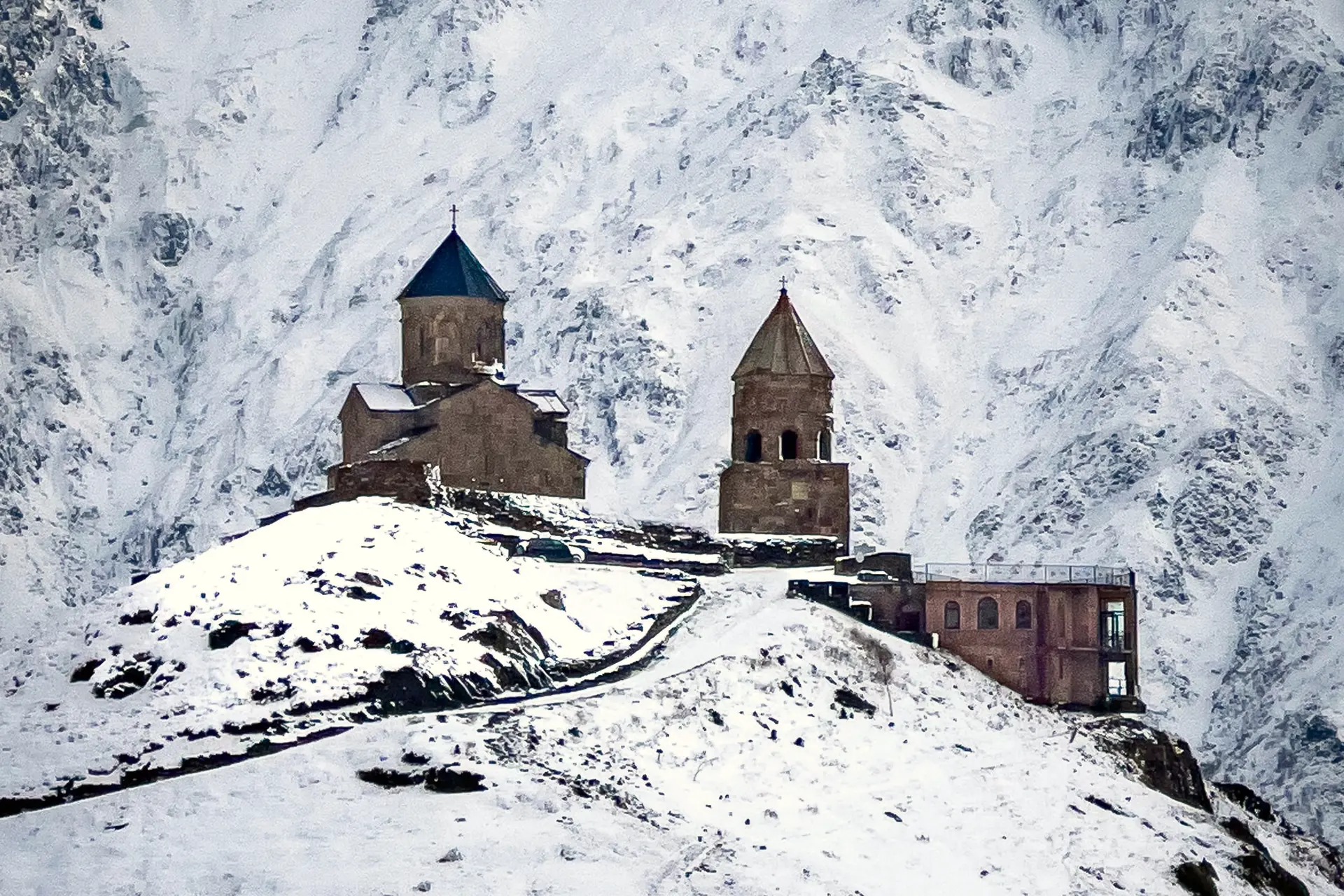 Winter
Kazbegi in winter
What Kazbegi is like in winter, when and why the Jvari Pass closes, how to check the road today, Gergeti in the snow and a winter day plan from Tbilisi.10 min read
Photos: Braveheart (CC BY-SA 4.0).